Report | Intelligent Investment
2026 Asia Pacific Real Estate Market Outlook Mid-Year Review
August 6, 2026 20 Minute Read

Executive Summary
Looking for a PDF of this content?

2026 APAC Real Estate Mid-Year Investment Market Outlook Event Recording
Full-year Asia Pacific economic growth has been revised upward from 3.9% to 4.3% on the back of robust demand for AI-related products and semiconductors. Australia’s GDP growth forecast has been downgraded, however, largely due to rising interest rates. While the interest rate cutting cycle had been predicted to come to an end, several markets, including Australia, Korea, and India, swiftly moved into a rate hike cycle in H1 2026 and may see one further rate hike in H2 2026.
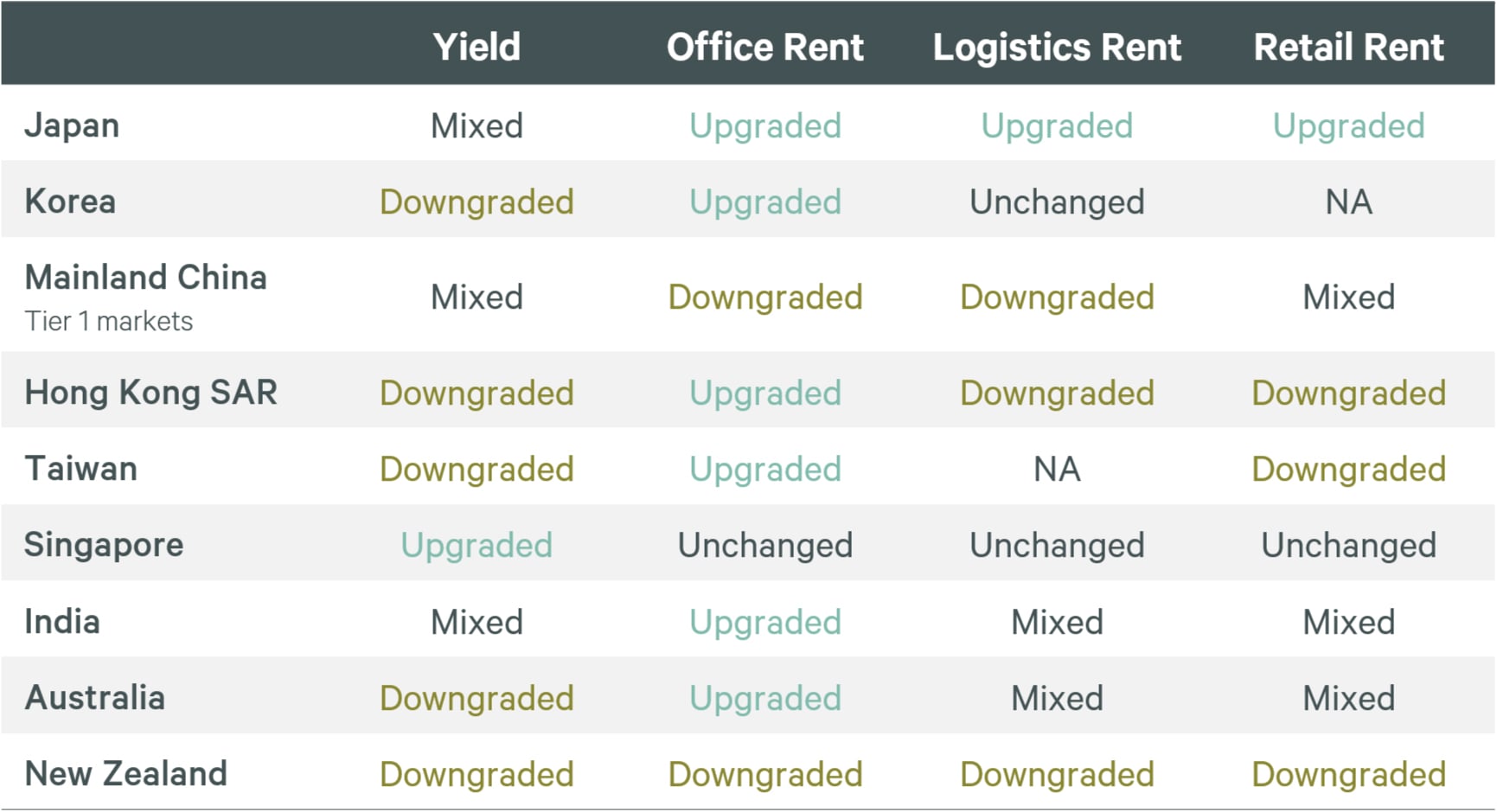
Commercial real estate investment rose by 27% y-o-y in H1 2026 despite rising interest rates and sustained geopolitical uncertainty. Transaction momentum is expected to moderate in H2 2026, however, as investors focus on markets with strong rental growth prospects, such as Tokyo, Sydney, and Brisbane. Yield expansion is therefore now anticipated across most major sectors in Australia and Hong Kong SAR, as well as for Greater Seoul logistics. In contrast, Singapore's outlook has been upgraded, supported by stronger capital market conditions and sustained investor demand.
The office sector has witnessed tight supply conditions across major gateway markets and core locations combined with persistent flight-to-quality demand; a trend expected to continue into H2 2026. While most mature markets recorded stronger-than-expected rental growth in the first six months of the year, leading to upward revisions to full-year forecasts, growth momentum is expected to moderate in the back-half. Tokyo will once again outperform, delivering another year of double-digit rental growth, while the recovery in Hong Kong SAR has exceeded expectations thanks to renewed demand from the financial sector. The rental decline in Shanghai's core districts is expected to stabilise as new supply tightens.
While the logistics sector remained resilient in H1 2026, there continued to be a performance gap between prime and secondary assets. Occupier demand in H2 2026 is expected to remain focused on modern, well-located facilities, particularly in supply-laden markets such as mainland China, Australia, and India. A shrinking pipeline from 2027 is set to lend further support to regional rents. Greater Tokyo's rental growth outlook has been upgraded, supported by broad-based domestic demand. The outlook for India and Australia is mixed, with softer expansion demand in the former and ongoing supply-side pressure in the latter. The rental outlook for mainland China and Hong Kong SAR has been downgraded amid elevated vacancy and more cautious occupier sentiment.
In the retail sector, limited new supply and strong demand for prime space ensured most markets recorded rental growth in H1 2026. This momentum is expected to continue into H2 2026, driven by new-to-market Asian brands and experiential concepts. Tokyo Ginza’s rental outlook has been upgraded amid tight availability and strong demand. In India's core markets, rents continue to grow but at a mild pace given a slowdown in high-quality supply, while uneven labour market conditions will weigh on rental growth in Australia. Hong Kong SAR's and Taiwan's rental outlook has been downgraded due to softer non-core leasing demand and pressure on retailer profitability.
ADR growth propelled Asia Pacific hotel performance in the first six months of the year, pushing up RevPAR y-o-y. However, occupancy remains uneven due to lower flight capacity and higher fuel costs. Vietnam and Korea outperformed in H1 2026 on the back of strong visitor arrivals, while the Maldives lagged amid Middle East aviation route disruption. Events and concerts are set to play an increasingly important role in driving the regional hotel market as they help generate performance spikes and create demand during the low season. ADRs are expected to remain on an upward trend due to a constrained pipeline resulting from rising construction costs. Further occupancy growth will depend on a sustained recovery in visitor arrivals.
Economy
Figure 1: 2026 GDP Growth Forecast Revisions (January vs July forecasts)
(Click to enlarge)
Figure 2: Interest Rate Outlook – Central Banks Tilt Hawkish
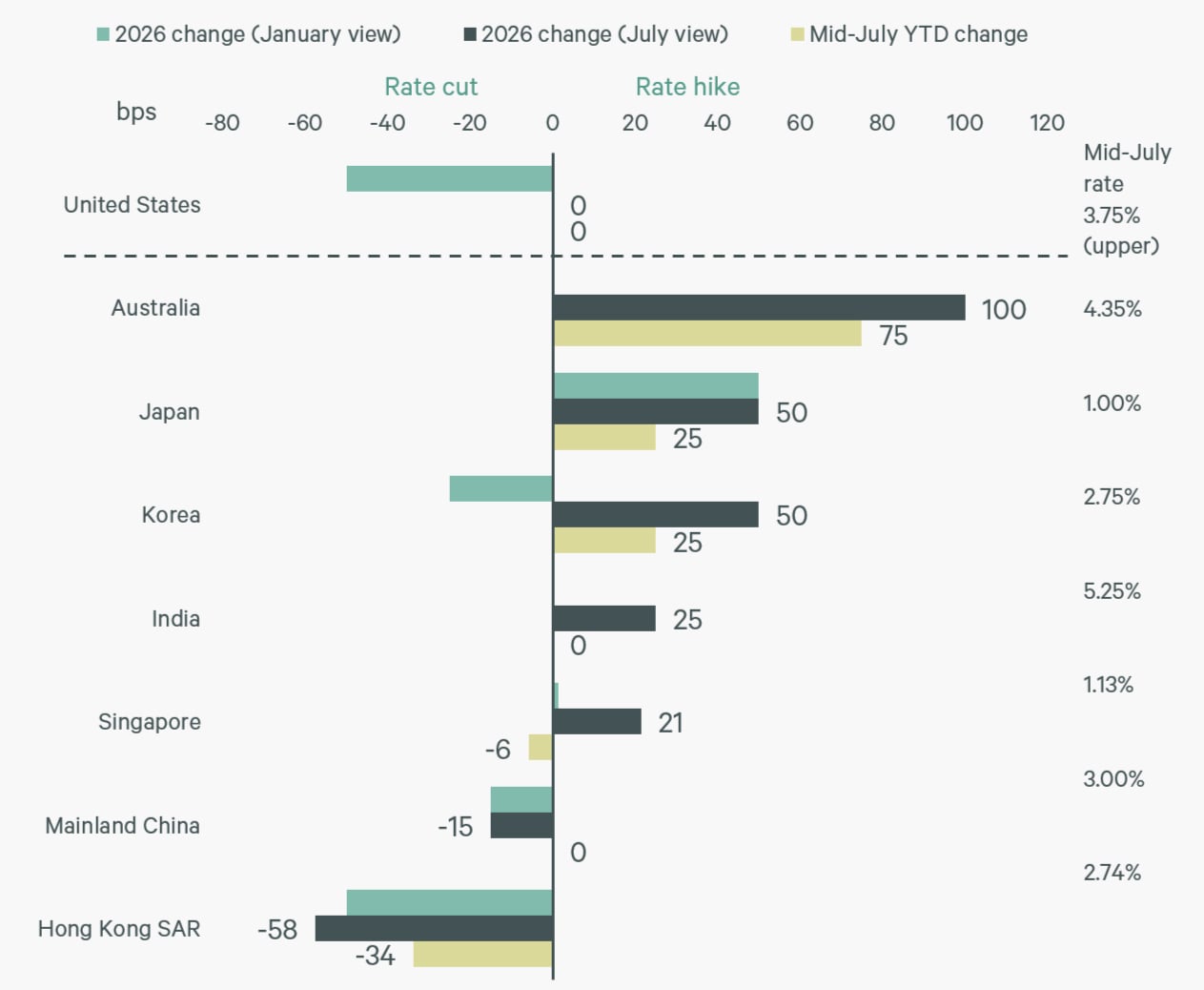
Note: Interest rates for Hong Kong SAR and Singapore refer to key market rates 1M HIBOR and 3M compounded SORA, respectively. The interest rate for mainland China refers to the 1Y Loan Prime Rate (LPR).

Capital Markets
Key changes to forecasts
Upgraded
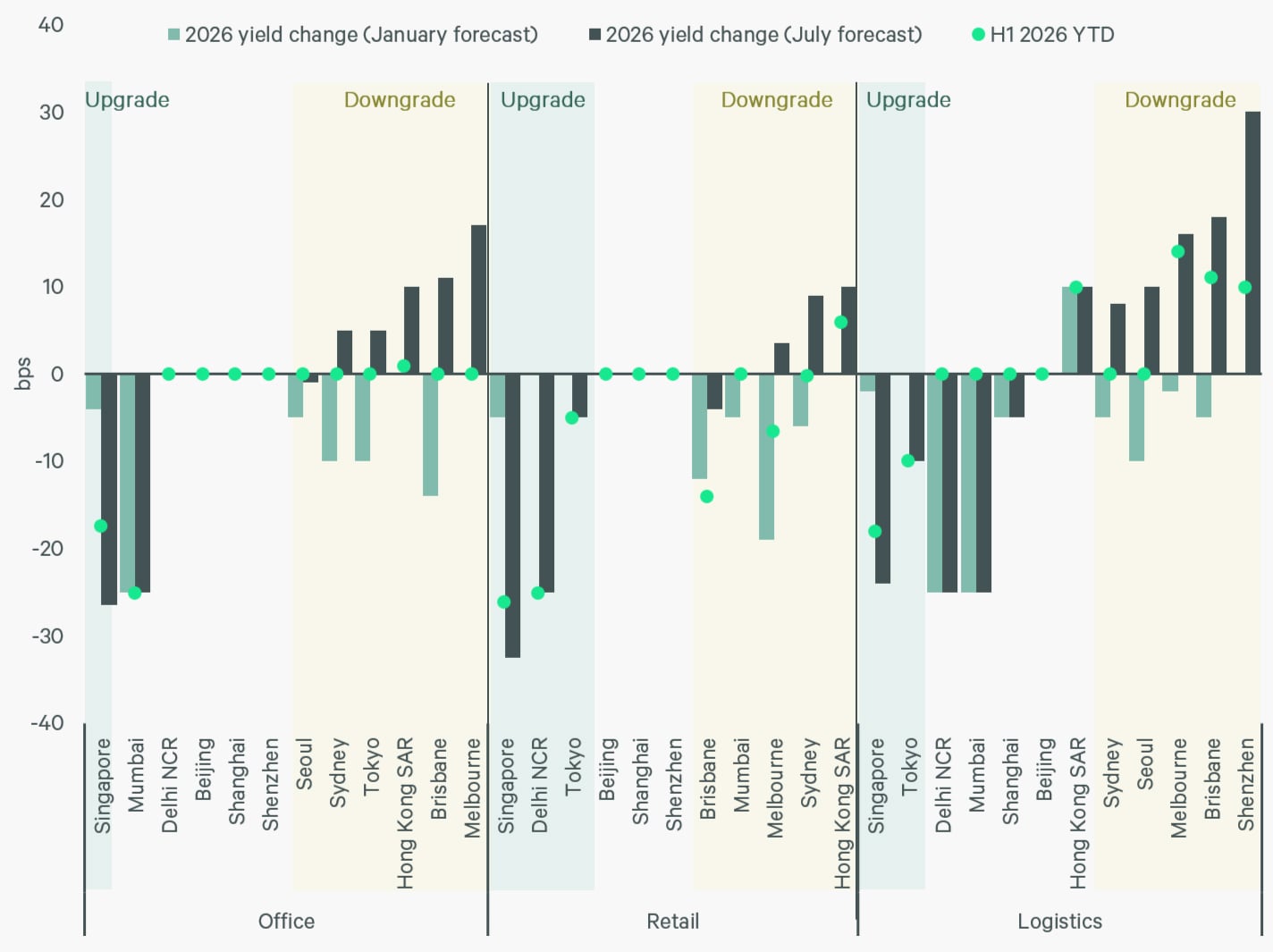
- Against the backdrop of persistently low interest rates, yields in Singapore are facing downward pressure after a flurry of large deals completed in H1 2026. A strong pipeline of activity in H2 2026 including several sizable assets should further compress yields over the remainder of 2026.
- Yields for Tokyo retail and logistics assets showed signs of compressing in H1 2026. Yield tightening in the retail sector was driven by strong demand from investors including family offices seeking prime retail assets in Ginza amid supply scarcity. Expectations of strong rental growth in prime industrial locations including the Tokyo Bay Area have helped push down logistics yields.
Downgraded
- Most major markets and sectors in Australia now expect yield expansion over the remainder of the year. This comes after the RBA hiked rates three times by a total of 75bps so far this year, with a fourth hike possible in H2 2026. The subsequent increase in bond yields may put upward pressure on property yields, especially for assets in secondary locations.
- In contrast to the retail and logistics sectors, office assets in Tokyo are forecasted to see some yield decompression in H2 2026 due to the ongoing rising interest rate cycle. Office yield expansion will vary by location, however, with core CBD assets likely to experience milder softening.
- In Hong Kong SAR, yield expansion is being driven by a combination of a faster than expected recovery in rental growth and weak institutional investor interest, resulting in sluggish movement in capital values.
- Against the backdrop of rising interest rates in Korea, logistics yields, especially those for cold storage, are forecasted to soften in Greater Seoul as investors seek discounted pricing for facilities suitable for conversion to dry assets.
Figure 3: Yield Change Forecast Between End-2025 and End-2026 (January vs July forecasts)
Source: CBRE Research, July 2026.

Office
Key changes to forecasts
Upgraded
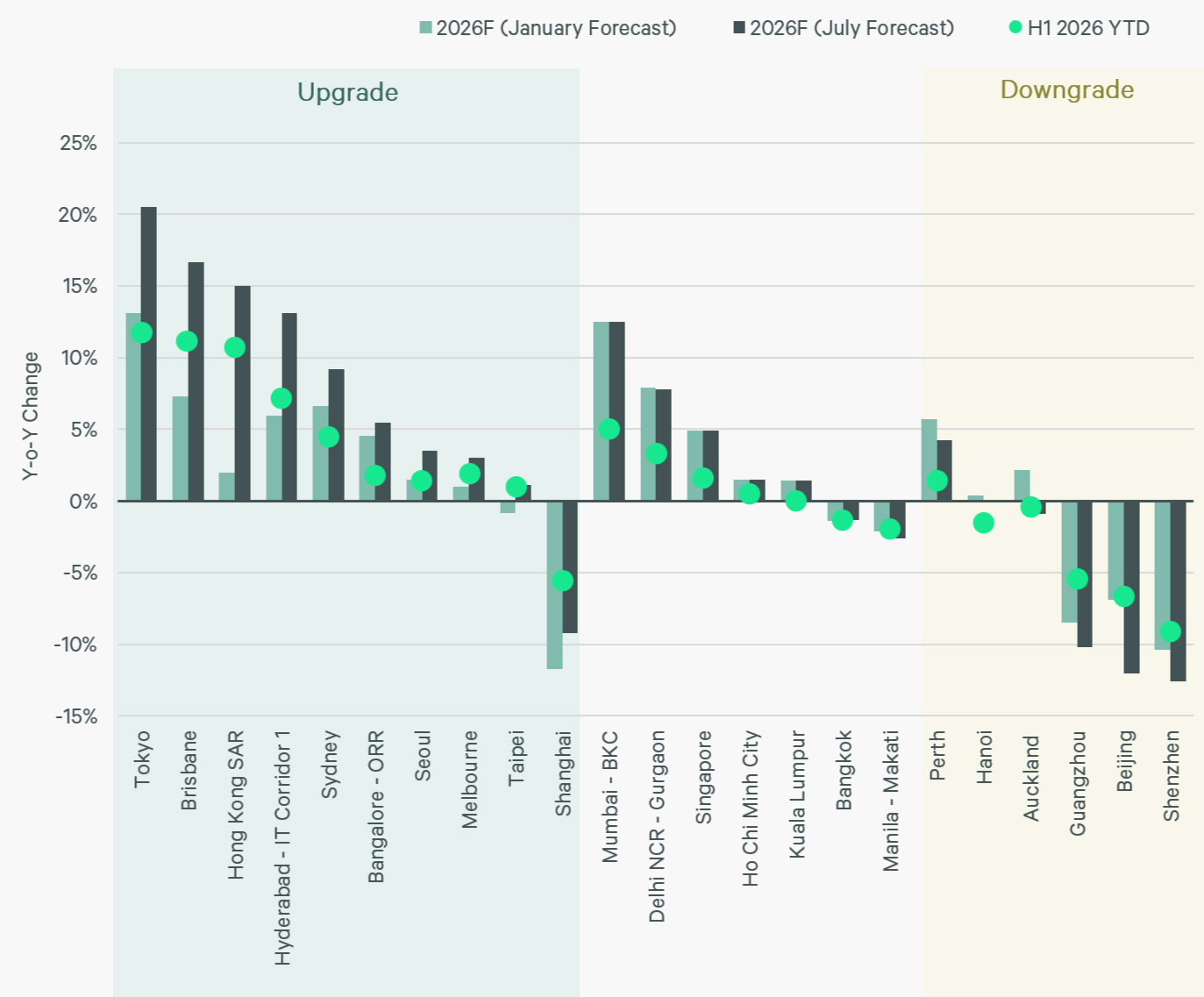
- In addition to traditional leaders such as Tokyo and Indian tier I cities, rental growth forecasts for Hong Kong SAR and Australia have been upgraded.
- Tokyo is projected to register rental full year rental growth of 20%, its highest in a decade. Limited availability and a robust pre-commitment rate of over 90% in H2 2026 supply mean landlords have the confidence to hike rents further.
- Among India's major markets, flight to quality and a strong talent pool are driving up rents in Hyderabad ITC 1, while occupiers continue to seek large floor space in Bangalore amid robust GCC absorption.
- Hong Kong Central’s rental outlook has been revised up by double digits amid robust demand from financial institutions, driving an overall rental recovery.
- Rental forecasts in most markets in Australia have been upgraded due to limited supply and rising construction costs. Brisbane achieved double-digit rental gains in H1 2026 and will continue to outperform. Rents in Sydney and Melbourne have been revised up amid declining incentives.
- While forecasts for Seoul and Taipei have been slightly revised up owing to tight availability, medium to long term supply pressure persists. Shanghai's rental decline is expected to narrow as core supply tightens.
Downgraded
- Mainland China will remain a regional laggard, with further rental declines expected amid high supply pressure. Beijing's landlords are accommodative amid elevated supply, while occupiers are looking to consolidate. The rental decline in Shenzhen is due to pockets of oversupply in Qianhai. Demand in Guangzhou remains soft as vacancy approaches a decade-high.
- Perth's rental growth momentum is normalising amid a mining sector slowdown and occupiers' heightened cost sensitivity. In Auckland, demand has been weaker than expected amid soft economic growth, prompting landlords to lower rents and offer higher incentives to attract tenants.

Logistics
Key changes to forecasts
Upgraded
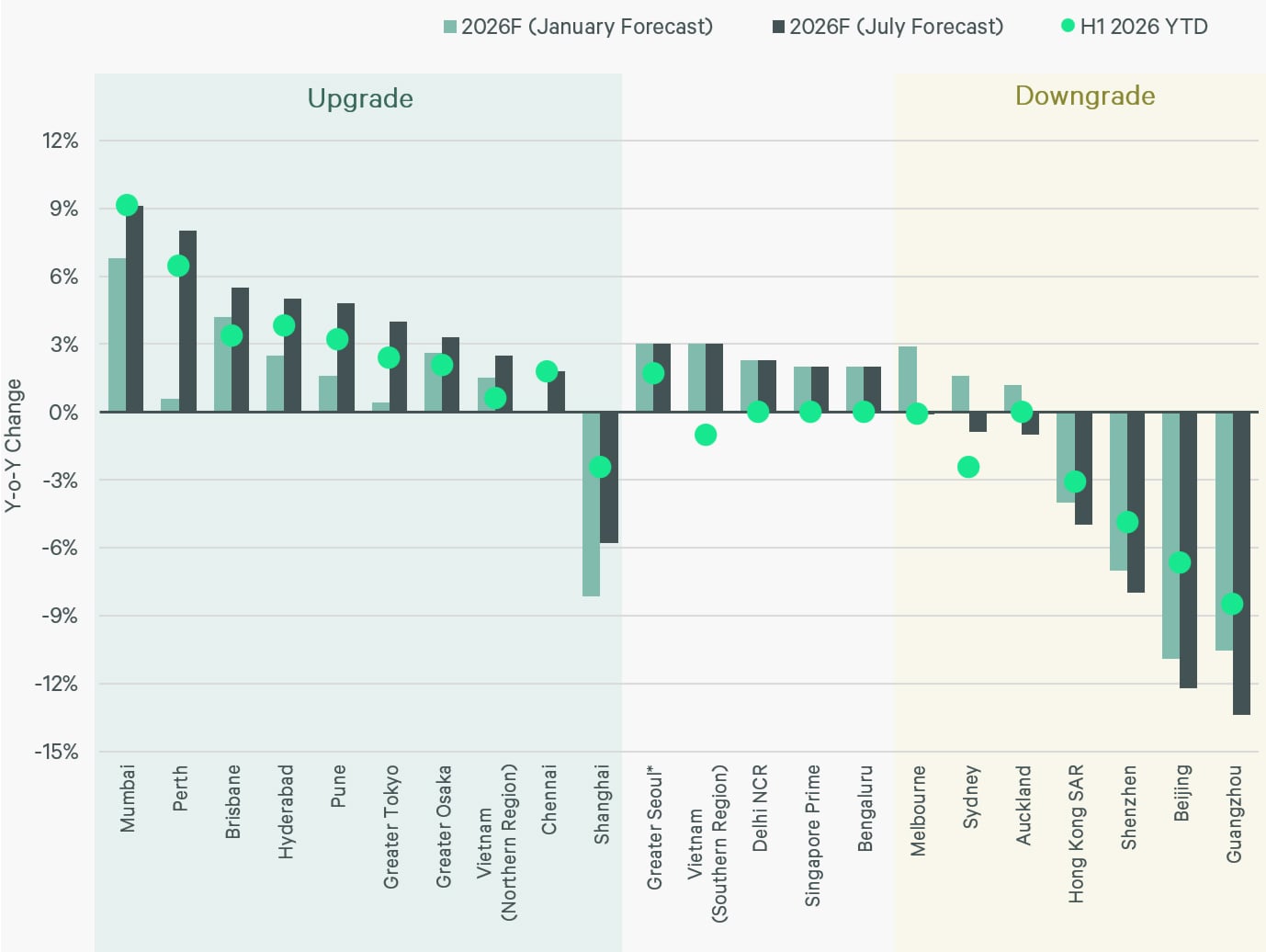
- Perth and Brisbane are outperforming, with the former enjoying solid demand growth driven by population expansion, and the latter witnessing rental gains amid tight vacancy and easing speculative supply.
- A few Indian markets reported rental growth in H1 2026, with Hyderabad, Pune and Chennai benefiting from incoming prime supply. In contrast, Mumbai saw rents driven higher by tightening availability in core submarkets. Rental growth is anticipated to remain modest as selected industries continue to favour cost-effective alternatives.
- Greater Tokyo and Greater Osaka continue to see steady broad-based domestic demand sustaining upward rental momentum.
- In the Northern region of Vietnam, export-driven manufacturing demand strengthened in H1 2026, particularly in the Haiphong area, providing positive prospects for growth in H2 2026.
- Shanghai's rental forecast has been raised, supported by upgrading and consolidation demand in core areas as tenants capitalise on attractive rents.
Downgraded
- In the Pacific, rental forecasts for Sydney, Melbourne and Auckland have been downgraded due to supply-side pressure. New supply concentrated around Sydney's Western Sydney Airport has pushed vacancy higher, triggering rebalancing in the broader market, while Melbourne's rents softened in anticipation of a supply surge in H2 2026. Auckland rents have corrected as speculative stock proves slow to absorb.
- Rental forecasts for most tier I cities in mainland China have been downgraded, with vacancy set to range from 25% to 45% by year-end. Guangzhou faces the steepest correction due to ultra-high new supply, while the outlook for Beijing and Shenzhen has also been cut, though supply is set to ease from 2027.
- Hong Kong SAR's forecast has been downgraded after landlords cut rents to secure tenants. Despite strong H1 2026 take-up, occupiers remain cost-sensitive amid the uncertain trade outlook, obstructing a rental recovery.
Figure 5: H1 2026 YTD and 2026F Asia Pacific Logistics Rental Forecast
Source: CBRE Research, July 2026.

Retail
Key changes to forecasts
Upgraded
- Retailers’ strong preference to be in Tokyo Ginza for brand exposure is expected to underpin further growth despite rents already standing at historical highs. The lack of availability in Ginza is boosting demand in Omotesando, Harajuku and Shibuya among retailers seeking space in Tokyo.
Downgraded
- Despite strong growth in retail sales in H1 2026, Hong Kong SAR can expect a milder rental recovery in the back-half of the year. Most retail sales growth is being generated by the online segment as brick-and-mortar retailers turn more cautious amid high operating costs.
- Rental growth in Taipei is expected to be limited and confined to tourist-oriented areas. Recent strong economic performance has failed to translate into sales as local consumers prefer spending abroad.
- Auckland's regional centre rents are falling due to the higher cost of living and rising unemployment rate amid a weaker economic outlook.
Mixed
- Growth in Australia's regional centres rents continues to be supported by ongoing population growth and limited new supply. Brisbane’s brighter economic outlook has boosted rental expectations but rising unemployment in Perth and Melbourne is weighing on rental growth.
- India (Mumbai and Delhi) core markets and Vietnam (Hanoi and Ho Chi Minh) CBD rents are at historical highs. Limited availability in these locations continue to push rents up, albeit at a milder pace. Further growth will rely on the addition of new high-quality supply.
- Tier I cities in mainland China will face further rental declines as upcoming supply exerts pressure on landlords. Shanghai and Shenzhen can expect slower rental decreases due to strong preleasing, while rents in Beijing and Guangzhou will correct further.
Figure 6: H1 2026 YTD and 2026F Asia Pacific Retail Rental Forecast

Source: CBRE Research, July 2026.

Hotels
Key changes to forecasts
ADR improves while occupancy varies
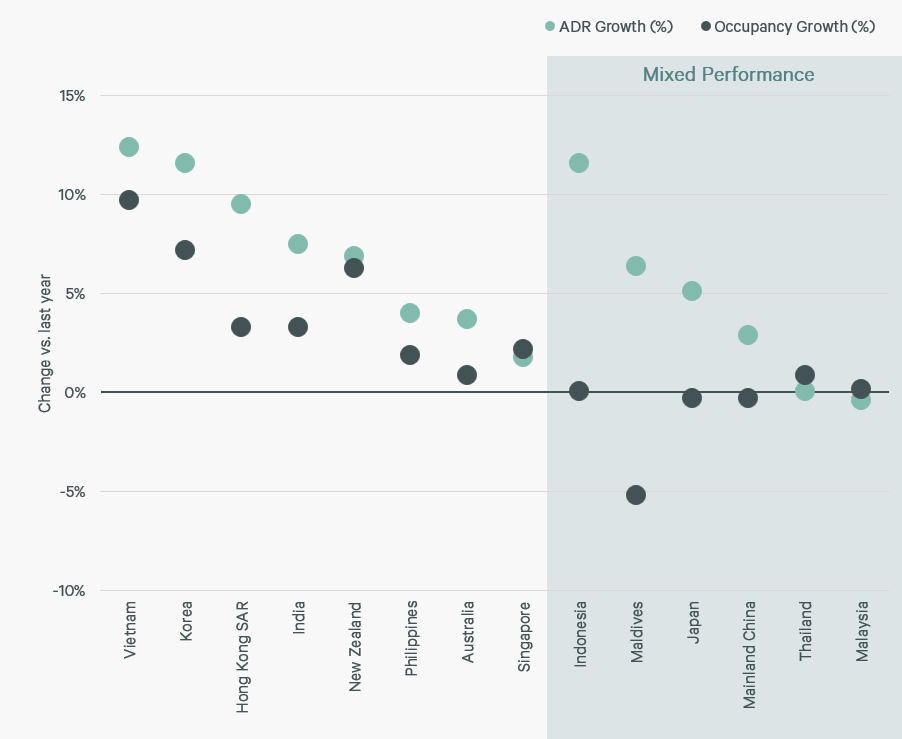
- Vietnam registered the strongest performance of any market in H1 2026 as tourist arrivals grew 15% y-o-y amid relaxed visa policies and expanded air connectivity, pushing up ADR and occupancy.
- The ongoing popularity of the Korean Wave along with the depreciation of the won helped tourist arrivals to Korea increase by 19% y-o-y, the highest in the region. The weak won has made hotels more affordable to tourists, supporting a 11.6% y-o-y increase in ADR.
- Hong Kong SAR ADR improved by 9.5% y-o-y on the back of a series of major MICE, cultural and sporting events along with limited new supply.
- ADR in Australia continued to register growth despite already reaching a historical high. Occupancy was stable.
- Singapore displayed resilient performance as the MICE events economy generated growth in both ADR and occupancy.
- Maldives’ hotel occupancy registered the sharpest decline in H1 2026 as the market continued to be negatively impacted by disruption to air routes to the Middle East along with rising fuel costs.
- While Japan's tourist arrivals edged down by 1% y-o-y due to a fall in mainland China tourists, this was largely offset by increases in visitors from Taiwan and Korea. Long-haul arrivals from the U.S. and Europe also picked up, with the higher spending power from these regions helping to boost ADR.
- Domestic demand was modest in mainland China in H1 2026. Growth in ADR was mainly led by major tourist destinations such as Shanghai and Sanya as looser visa policies lured overseas travellers.
- A steady recovery in mainland Chinese tourists to Thailand offset a decline from long-haul travellers, ensuring performance in H1 2026 was mostly flat y-o-y.
Figure 7: ADR Growth & Occupancy Change (% difference) – H1 2026 y-t-d vs. H1 2025 y-t-d

Event Recording
Related Mid-Year Market Outlook Insights
- Intelligent Investment
U.S. Real Estate Market Outlook Midyear Review 2026
August 4, 2026 40 Minute Read

Prime office, industrial and data centers lead CRE's 2026 recovery. See where momentum is building for the rest of the year.
- Book | Intelligent Investment
UK Real Estate Market Outlook Midyear Review 2026
August 4, 2026 56 Minute Read

How is UK real estate performing in 2026? CBRE's midyear review updates forecasts across offices, logistics, data centres, retail, and the living sectors.
- Book | Intelligent Investment
European Real Estate Market Outlook Midyear Review 2026
August 6, 2026 74 Minute Read

How is European real estate performing at midyear 2026? CBRE's review updates forecasts across the economy, capital markets, living, logistics, and offices.
Research Contacts




Business Contacts
Greg Hyland
Head of Capital Markets, Asia Pacific

Richard Stevenson
Managing Director, Head of Office Leasing, Advisory Services, Asia Pacific

Michael Bowens
Managing Director, Head of Industrial & Logistics Leasing, Advisory Services, Asia Pacific

Vivek Kaul
Managing Director, Head of Retail Leasing, Advisory Services, Asia


